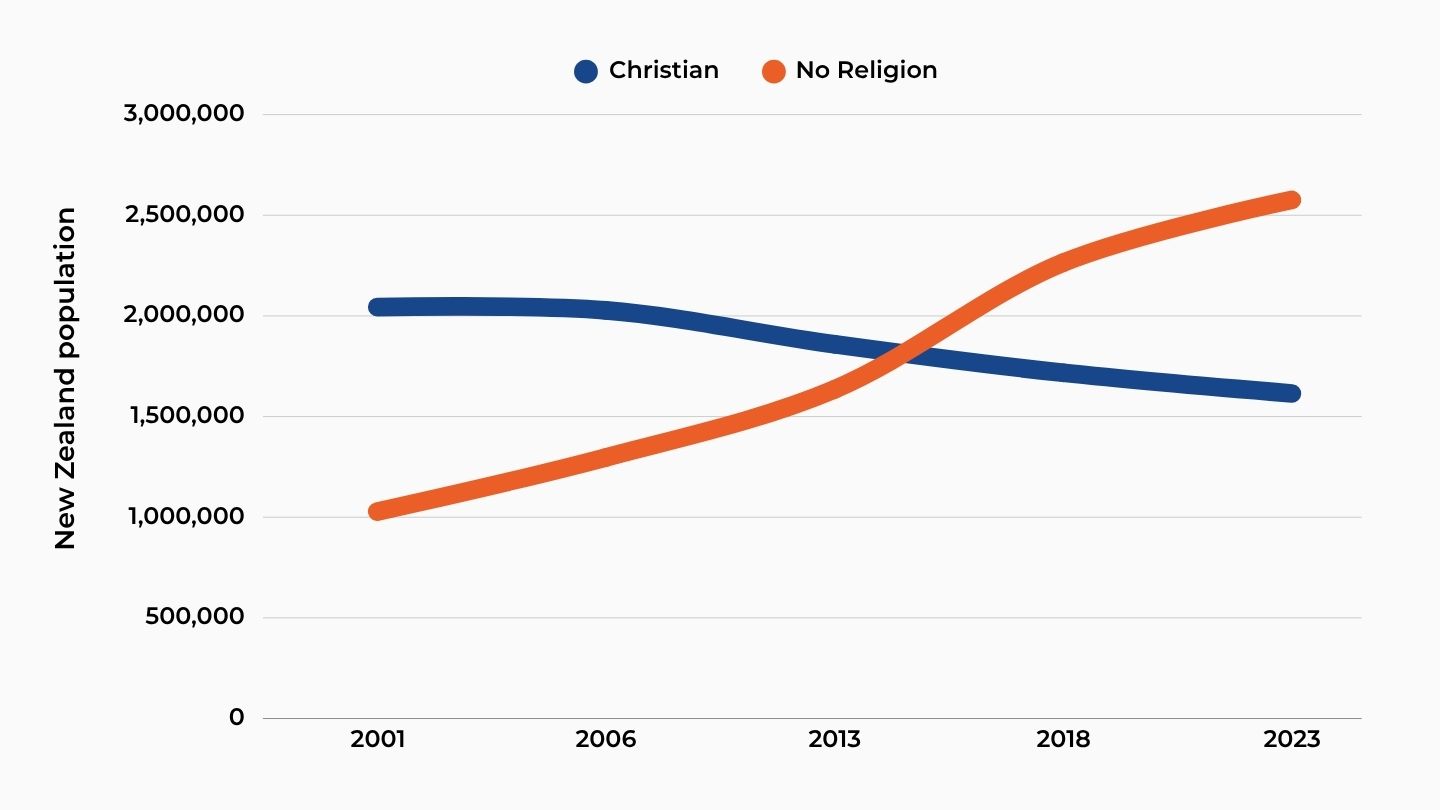
A glance at New Zealand census statistics will show you an unmistakably widening gap between those checking the “Christian” box and those selecting “no religion”. From the turn of the century, the two lines on the graph run more perpendicular than parallel as they meet around 2014 and continue their separate ways.1
Assumptions have changed. Words don’t carry the same common meaning they used to, and Christian leaders don’t have the same mana in their communities. The church, which was once considered the moral backbone of society, is now a source of controversy and skepticism.
There’s no singular reason we can point to the change in culture. But there’s been some good research done to help us understand the current climate of faith in our country.
In his PhD thesis, Dr Mike Crudge interviewed spiritual but non-Christian, unchurched New Zealanders.2 His aim was to answer the question: What are the factors that shape and create perceptions of the Christian church in post-Christendom New Zealand, for spiritual people who have not been Christianised?
From these interviews, he gleaned nine main perceptions.
He then conducted a survey of around one thousand people based around these perceptions. The data backed up his research.
Those perceptions are pretty harsh. Of course, we don’t agree with statements like “Christianity is not relevant or necessary”!
Isn’t it interesting to note that the majority of those perceptions are around flawed Christian character and corrupt institutions?
The 2023 Wilberforce Faith and Belief study also points to faults in Christian behaviour. When participants were asked what aspects of Christianity they found problematic or challenging, these were the top six responses:
“All but one of the barriers to engagement with Christianity are symptomatic of a poorly embodied gospel,” said Karen Kemp from Centre for Church Leadership in response to these findings.
People are, understandably, put off when they see a disconnect between Christian values and Christian behaviour. Five out of six top barriers to Christianity are self-inflicted – and resolvable.
In the next part of his thesis, Dr Crudge took those nine perceptions to several groups of church leaders to gauge their reactions. Their feedback was remarkably defensive.
“It’s not easy being Christian. We’re being judged by the actions of a few bad eggs.”
“They just don’t get it. They would understand if they just came to church.”
Leaders agreed that something got lost in translation. But even though church leaders are the communicators of the gospel, these leaders did not see themselves as being part of the translation problem – they put the blame on the receivers of the communication. If these critics would just walk into church and give us a chance, they would get it, right?
I thought this metaphor Crudge used was insightful:
[It’s as if Christians are] saying “Come on in – the water’s fine”, without realising that the people outside the pool have been put off swimming, first, by some of the swimmers, and second, by the information that there are sharks in the water.
It’s not about arguing over whether there are sharks in the water. The first step is understanding that this is how it may appear to many people. And there have, in fact, been some nasty sharks preying in churches. We’re left to empathise and regain trust with the hurt and the skeptical.
“My data suggests that the church needs to do a better job of communicating what it can do, and why it matters,” Crudge concluded.
So how should we respond?
The answer is not to shy away from our faith or focus all our efforts on making Sunday services more “relevant”.
“Formed by a story.” That, to me, is beautiful. Our Christian identity comes from a story of creation and redemption, written in the Bible and being written in our hearts by the living Spirit. It’s what makes us unique. That means our job isn’t to argue a better case but to tell a more compelling story – one that is backed up by our clear and trustworthy discipleship. We challenge those perceptions by exhibiting a vibrant relationship with Jesus that spills out into our everyday interactions and decisions.

Don’t be discouraged by the post-Christendom society we live in. The early church had no institutional power or societal influence, yet it thrived. People around them were drawn to the way they lived their lives: sharing resources with the poor, caring for widows and orphans, rescuing babies left for dead, visiting prisoners, staying faithful to their spouses, being truthful in their business transactions, showing dignity to women and slaves. Their conduct was totally counter-cultural.
Alan Jamieson said that “if God is drawing people who have a hunger for meaning, and a deep desire for credible hope, they will be looking at our lives and the life of our church to see if there is evidence of that credible meaning and evidenced hope in us.”5
The good news is that we still carry the good news. And people are still curious about it. Every human being is created with an innate need for meaning, purpose and hope – and we know where to find those!
We don’t have to compromise the truth of the gospel to reach people. But it helps to understand them. It’s like being a missionary – every missionary learns about the culture they’re going to in order to best communicate their message. We are missionaries to our own society. We need to find common ground.
So what common ground can we step onto?
How can you build trust with the community around you? What opportunities do you have to break down barriers and test assumptions? You might want to consider how your parish could work to challenge one of those nine perceptions.
Be encouraged that the story that forms us is as magnetic and relevant as it ever has been. Let’s not get in the way of it.
1 New Zealand Census data, Stats NZ.
2 Mike Crudge, “The disconnected church: a critical examination of the communication of the Christian church in New Zealand”, 2013.
3 “Faith and Belief, Te Patapātai Whakapono: Exploring the spiritual landscape in Aotearoa New Zealand”, Wilberforce Foundation, 2023.
4 Stanley Hauerwas, A Community of Character: Toward a Constructive Christian Social Ethic, 1981.
5 Alan Jamieson, “Is a revival coming?” Baptist Churches of New Zealand, 2025.
6 “Faith and Belief”, Wilberforce Foundation, for all statistics from “Spirituality” to here.
7 “The Patmos Typology Report”, British and Foreign Bible Society, 2025.
Check out other articles in the
series below.
More articles in the
series are to come.
We have invited these writers to share their experiences, ideas and opinions in the hope that these will provoke thought, challenge you to go deeper and inspire you to put your faith into action. These articles should not be taken as the official view of the Nelson Diocese on any particular matter.
A glance at New Zealand census statistics will show you an unmistakably widening gap between those checking the “Christian” box and those selecting “no religion”. From the turn of the century, the two lines on the graph run more perpendicular than parallel as they meet around 2014 and continue their separate ways.1
Assumptions have changed. Words don’t carry the same common meaning they used to, and Christian leaders don’t have the same mana in their communities. The church, which was once considered the moral backbone of society, is now a source of controversy and skepticism.
There’s no singular reason we can point to the change in culture. But there’s been some good research done to help us understand the current climate of faith in our country.
In his PhD thesis, Dr Mike Crudge interviewed spiritual but non-Christian, unchurched New Zealanders.2 His aim was to answer the question: What are the factors that shape and create perceptions of the Christian church in post-Christendom New Zealand, for spiritual people who have not been Christianised?
From these interviews, he gleaned nine main perceptions.
He then conducted a survey of around one thousand people based around these perceptions. The data backed up his research.
Those perceptions are pretty harsh. Of course, we don’t agree with statements like “Christianity is not relevant or necessary”!
Isn’t it interesting to note that the majority of those perceptions are around flawed Christian character and corrupt institutions?
The 2023 Wilberforce Faith and Belief study also points to faults in Christian behaviour. When participants were asked what aspects of Christianity they found problematic or challenging, these were the top six responses:
“All but one of the barriers to engagement with Christianity are symptomatic of a poorly embodied gospel,” said Karen Kemp from Centre for Church Leadership in response to these findings.
People are, understandably, put off when they see a disconnect between Christian values and Christian behaviour. Five out of six top barriers to Christianity are self-inflicted – and resolvable.
In the next part of his thesis, Dr Crudge took those nine perceptions to several groups of church leaders to gauge their reactions. Their feedback was remarkably defensive.
“It’s not easy being Christian. We’re being judged by the actions of a few bad eggs.”
“They just don’t get it. They would understand if they just came to church.”
Leaders agreed that something got lost in translation. But even though church leaders are the communicators of the gospel, these leaders did not see themselves as being part of the translation problem – they put the blame on the receivers of the communication. If these critics would just walk into church and give us a chance, they would get it, right?
I thought this metaphor Crudge used was insightful:
[It’s as if Christians are] saying “Come on in – the water’s fine”, without realising that the people outside the pool have been put off swimming, first, by some of the swimmers, and second, by the information that there are sharks in the water.
It’s not about arguing over whether there are sharks in the water. The first step is understanding that this is how it may appear to many people. And there have, in fact, been some nasty sharks preying in churches. We’re left to empathise and regain trust with the hurt and the skeptical.
“My data suggests that the church needs to do a better job of communicating what it can do, and why it matters,” Crudge concluded.
So how should we respond?
The answer is not to shy away from our faith or focus all our efforts on making Sunday services more “relevant”.
“Formed by a story.” That, to me, is beautiful. Our Christian identity comes from a story of creation and redemption, written in the Bible and being written in our hearts by the living Spirit. It’s what makes us unique. That means our job isn’t to argue a better case but to tell a more compelling story – one that is backed up by our clear and trustworthy discipleship. We challenge those perceptions by exhibiting a vibrant relationship with Jesus that spills out into our everyday interactions and decisions.
Don’t be discouraged by the post-Christendom society we live in. The early church had no institutional power or societal influence, yet it thrived. People around them were drawn to the way they lived their lives: sharing resources with the poor, caring for widows and orphans, rescuing babies left for dead, visiting prisoners, staying faithful to their spouses, being truthful in their business transactions, showing dignity to women and slaves. Their conduct was totally counter-cultural.
Alan Jamieson said that “if God is drawing people who have a hunger for meaning, and a deep desire for credible hope, they will be looking at our lives and the life of our church to see if there is evidence of that credible meaning and evidenced hope in us.”5
The good news is that we still carry the good news. And people are still curious about it. Every human being is created with an innate need for meaning, purpose and hope – and we know where to find those!
We don’t have to compromise the truth of the gospel to reach people. But it helps to understand them. It’s like being a missionary – every missionary learns about the culture they’re going to in order to best communicate their message. We are missionaries to our own society. We need to find common ground.
So what common ground can we step onto?
How can you build trust with the community around you? What opportunities do you have to break down barriers and test assumptions? You might want to consider how your parish could work to challenge one of those nine perceptions.
Be encouraged that the story that forms us is as magnetic and relevant as it ever has been. Let’s not get in the way of it.
Check out other articles in the
series below.
More articles in the
series are to come.