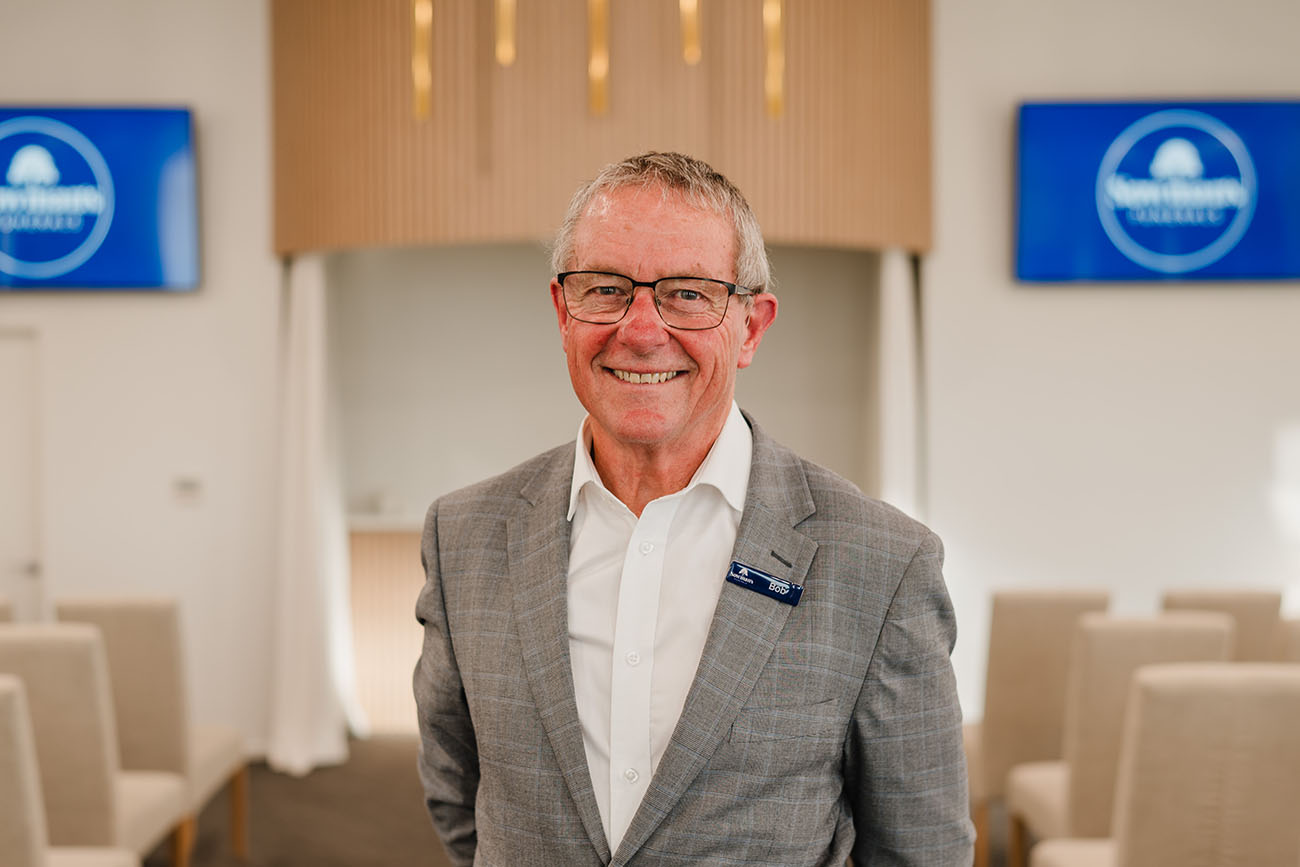
After 35 years of leading parishes, Rev Bob Barnes stepped down from the role of vicar at Nativity in Blenheim for a change of season. He has now been a funeral director and assistant embalmer at Sowman’s Funerals for the past seven years.
I met with Bob to ask him about his work in caring for the dead and their mourners. It seems like a tough and melancholy business to be in, so I expected quite a solemn conversation. Yet I was blown away by Bob’s cheerful disposition towards his work, and the joy and satisfaction he finds from walking alongside the grieving.
Here’s our kōrero.
Bob: I was born in 1956 – the year of the Golden Holden – and baptised at about six weeks of age in the little Anglican church of St John’s, Ohakune. A few years later we moved to Whanganui. There I was put through The Great Anglican Sausage Machine. I was sent to Sunday School, and eventually confirmed. About that time, I remember meeting Mum at our church in town after school, when I had my first sense of a calling to ordination. Mum was praying about something, and while I was sitting there in the silence, it was like I heard two voices talking – I presumed they were angels. And one said to the other, “That’s Bob. One day he's going to be a minister.” What? I didn’t like that.
After confirmation I didn’t go to church anymore. Eventually I left school at the end of the fifth form and did an apprenticeship in radio and TV. At the end of the first year, a whole series of events happened over a few months – something was happening for me. My sister cottoned on and started praying for me, and gave me a Bible. So I started at Genesis, as you do, but when she found out she said, “No, no, no, you start at Matthew or Mark or Luke.” I said, “But that's cheating!”
I started going on to church again – it was Christ Church in Whanganui. From then God had me all the way. Within a year or so this call to ordination was repeated and became very obvious.
Bob: Libby and I have always worked as a team in ministry. We married in 1979. I worked for a year in Petone Parish as a non-stipendary lay reader, preaching, leading the youth group, all of that stuff. We went to St John's College 1981-83 where our first two children were born, after which I was appointed assistant curate at St Mary’s Hāwera in South Taranaki. Being vicar of Hunterville followed, then Waitara, then All Saints Community Church in Hamilton until 2010 when I became priest-in-charge at Te Awamutu while we discerned our next calling. We thought it was to military chaplaincy, but not so! Nativity, Blenheim came up. I put my name in the hat for that, and within a very short period of time everything fell into place and we were here. We loved it, but I couldn’t have done it without Libby as my team mate.
Bob: Towards the end of the seven years, I was vision casting with the parish for a new way forward. In that process, I realised that it needed somebody else to take the parish on from there.
I thought I’d be the vicar of parishes until the day I could no longer. But long story short, a position here at Sowman’s Funerals in Blenheim came up, and in 2019 I ended up here as funeral director and assistant embalmer.
It lets me be the pastor without having to be the CEO. I loved being the vicar of parishes, but primarily I'm a pastor.
Bob: You never know until the end of the day.
When somebody dies, the phone rings. It might be the police, and we may have to go to something like a car crash, or somebody’s home, then we take them back to the mortuary, liaise with the coroner, and often that results in a post-mortem. If it’s somebody who’s arranged their funeral with us, we arrange to transfer the person into our care. We meet with the family and talk about what they want for the funeral and how they want to say goodbye.
The job is so varied. I can turn up here at eight o’clock and I think I’m going to do this, that or the other thing, but then the phone rings and I’m out for the day. That’s what I’ve enjoyed about all my jobs right from when I was an apprentice. Similarly, when I was in parish work, it was always different.
And I rather enjoy those interruptions. Usually.
Bob: It's just about caring for people.
And every family is different. They’re all different and they’re all special. Sometimes people have what’s called a simple cremation, and some families don’t want to have the ashes back so they ask us to dispose of them. Others decide they’re going to do a full community farewell at the pub at Canvastown or wherever. That's one of the things I like about it – the variety, and that I can make a difference in people’s lives.
Bob: Ignore it and it won’t happen, right? I had a friend who used to say the same about Covid. “If I don't test for Covid, then I don't get it!”
Bob: No, not hugely. It's been a lifelong development – I’ve never died before, so I don't know all the answers… What I do know is what Jesus tells me through the Gospels, and people’s stories.
It’s interesting – we’ve got such an agnostic society now, and a lot of people with different faiths. In my second year here, there was a Hindu family who had a member die, and so it was really good for me being able to talk with them as an Anglican priest, but in my role as Funeral Director. I’m able to relate with them because we believe in – to put it loosely – a spiritual way.
Often people say they’re not religious, but of course everybody is, and I enjoy helping them to explore that a little bit.
Bob: Everybody believes in something. Very seldom you get an absolutely through-and-through atheist. Probably most people are agnostic.
I don’t flaunt it, but I never make a secret of the fact that I was the vicar of Anglican parishes for 35 years, and it’s not unusual for me to be asked to take the funeral. Recently a man had died and the family said they just wanted something very quick and informal – but that the man had some quasi-Christian background. So they said, “Oh, you could do this service, couldn't you?” So we had a wee service based around the Anglican prayer book funeral liturgy.
Bob: Some of them are. My take on it is I’m here to make a difference and to add dignity in the situation. The person may have died by suicide, or the family haven’t been able to say goodbye, or the family have factions between them. And most families do.
I often say, family is the only institution run by its own inmates. The vast majority of families have somebody who they are apologising for. So if I can make a difference and put them at ease, then that in itself helps me to take care of myself because I’ve helped somebody get through something pretty tough. That makes me feel good.
Also I’ve got two bikes, a mountain bike and a road bike. In the morning, I have my quiet time and read the Scriptures, then I get on the mountain bike for a ride. Then I take my road bike to work, and I ride it home. It’s 2.5 kilometres to work but it can be 50 or 60 kilometres to get home – I take the scenic route. Because exercise helps with the hard times.
I’ve also got a lousy sense of humour as you may have picked up, and that helps.
Plus I'm still part of the Anglican Communion. That keeps everything intact, it’s about being connected.
Bob: The hardest thing, I sometimes joke, is when I get up in the morning and think, which white shirt will I put on today? It’s probably when I’m asked to do something differently, administratively for example. It’s challenging but I have the attitude that if that’s the way the boss wants it, that’s how it’s done. I’ve sat in their chair for 35 years and those decisions are way over my pay scale now!
I always say to families, “My job is to make your job easier.” Maybe in summary it’s what I said earlier, it’s about being the pastor without being the CEO.
God’s been good in all of it. And that’s it. “God is good all the time. All the time God is good.”
Check out other articles in the
series below.
More articles in the
series are to come.
We have invited these writers to share their experiences, ideas and opinions in the hope that these will provoke thought, challenge you to go deeper and inspire you to put your faith into action. These articles should not be taken as the official view of the Nelson Diocese on any particular matter.
After 35 years of leading parishes, Rev Bob Barnes stepped down from the role of vicar at Nativity in Blenheim for a change of season. He has now been a funeral director and assistant embalmer at Sowman’s Funerals for the past seven years.
I met with Bob to ask him about his work in caring for the dead and their mourners. It seems like a tough and melancholy business to be in, so I expected quite a solemn conversation. Yet I was blown away by Bob’s cheerful disposition towards his work, and the joy and satisfaction he finds from walking alongside the grieving.
Here’s our kōrero.
Bob: I was born in 1956 – the year of the Golden Holden – and baptised at about six weeks of age in the little Anglican church of St John’s, Ohakune. A few years later we moved to Whanganui. There I was put through The Great Anglican Sausage Machine. I was sent to Sunday School, and eventually confirmed. About that time, I remember meeting Mum at our church in town after school, when I had my first sense of a calling to ordination. Mum was praying about something, and while I was sitting there in the silence, it was like I heard two voices talking – I presumed they were angels. And one said to the other, “That’s Bob. One day he's going to be a minister.” What? I didn’t like that.
After confirmation I didn’t go to church anymore. Eventually I left school at the end of the fifth form and did an apprenticeship in radio and TV. At the end of the first year, a whole series of events happened over a few months – something was happening for me. My sister cottoned on and started praying for me, and gave me a Bible. So I started at Genesis, as you do, but when she found out she said, “No, no, no, you start at Matthew or Mark or Luke.” I said, “But that's cheating!”
I started going on to church again – it was Christ Church in Whanganui. From then God had me all the way. Within a year or so this call to ordination was repeated and became very obvious.
Bob: Libby and I have always worked as a team in ministry. We married in 1979. I worked for a year in Petone Parish as a non-stipendary lay reader, preaching, leading the youth group, all of that stuff. We went to St John's College 1981-83 where our first two children were born, after which I was appointed assistant curate at St Mary’s Hāwera in South Taranaki. Being vicar of Hunterville followed, then Waitara, then All Saints Community Church in Hamilton until 2010 when I became priest-in-charge at Te Awamutu while we discerned our next calling. We thought it was to military chaplaincy, but not so! Nativity, Blenheim came up. I put my name in the hat for that, and within a very short period of time everything fell into place and we were here. We loved it, but I couldn’t have done it without Libby as my team mate.
Bob: Towards the end of the seven years, I was vision casting with the parish for a new way forward. In that process, I realised that it needed somebody else to take the parish on from there.
I thought I’d be the vicar of parishes until the day I could no longer. But long story short, a position here at Sowman’s Funerals in Blenheim came up, and in 2019 I ended up here as funeral director and assistant embalmer.
It lets me be the pastor without having to be the CEO. I loved being the vicar of parishes, but primarily I'm a pastor.
Bob: You never know until the end of the day.
When somebody dies, the phone rings. It might be the police, and we may have to go to something like a car crash, or somebody’s home, then we take them back to the mortuary, liaise with the coroner, and often that results in a post-mortem. If it’s somebody who’s arranged their funeral with us, we arrange to transfer the person into our care. We meet with the family and talk about what they want for the funeral and how they want to say goodbye.
The job is so varied. I can turn up here at eight o’clock and I think I’m going to do this, that or the other thing, but then the phone rings and I’m out for the day. That’s what I’ve enjoyed about all my jobs right from when I was an apprentice. Similarly, when I was in parish work, it was always different.
And I rather enjoy those interruptions. Usually.
Bob: It's just about caring for people.
And every family is different. They’re all different and they’re all special. Sometimes people have what’s called a simple cremation, and some families don’t want to have the ashes back so they ask us to dispose of them. Others decide they’re going to do a full community farewell at the pub at Canvastown or wherever. That's one of the things I like about it – the variety, and that I can make a difference in people’s lives.
Bob: Ignore it and it won’t happen, right? I had a friend who used to say the same about Covid. “If I don't test for Covid, then I don't get it!”
Bob: No, not hugely. It's been a lifelong development – I’ve never died before, so I don't know all the answers… What I do know is what Jesus tells me through the Gospels, and people’s stories.
It’s interesting – we’ve got such an agnostic society now, and a lot of people with different faiths. In my second year here, there was a Hindu family who had a member die, and so it was really good for me being able to talk with them as an Anglican priest, but in my role as Funeral Director. I’m able to relate with them because we believe in – to put it loosely – a spiritual way.
Often people say they’re not religious, but of course everybody is, and I enjoy helping them to explore that a little bit.
Bob: Everybody believes in something. Very seldom you get an absolutely through-and-through atheist. Probably most people are agnostic.
I don’t flaunt it, but I never make a secret of the fact that I was the vicar of Anglican parishes for 35 years, and it’s not unusual for me to be asked to take the funeral. Recently a man had died and the family said they just wanted something very quick and informal – but that the man had some quasi-Christian background. So they said, “Oh, you could do this service, couldn't you?” So we had a wee service based around the Anglican prayer book funeral liturgy.
Bob: Some of them are. My take on it is I’m here to make a difference and to add dignity in the situation. The person may have died by suicide, or the family haven’t been able to say goodbye, or the family have factions between them. And most families do.
I often say, family is the only institution run by its own inmates. The vast majority of families have somebody who they are apologising for. So if I can make a difference and put them at ease, then that in itself helps me to take care of myself because I’ve helped somebody get through something pretty tough. That makes me feel good.
Also I’ve got two bikes, a mountain bike and a road bike. In the morning, I have my quiet time and read the Scriptures, then I get on the mountain bike for a ride. Then I take my road bike to work, and I ride it home. It’s 2.5 kilometres to work but it can be 50 or 60 kilometres to get home – I take the scenic route. Because exercise helps with the hard times.
I’ve also got a lousy sense of humour as you may have picked up, and that helps.
Plus I'm still part of the Anglican Communion. That keeps everything intact, it’s about being connected.
Bob: The hardest thing, I sometimes joke, is when I get up in the morning and think, which white shirt will I put on today? It’s probably when I’m asked to do something differently, administratively for example. It’s challenging but I have the attitude that if that’s the way the boss wants it, that’s how it’s done. I’ve sat in their chair for 35 years and those decisions are way over my pay scale now!
I always say to families, “My job is to make your job easier.” Maybe in summary it’s what I said earlier, it’s about being the pastor without being the CEO.
God’s been good in all of it. And that’s it. “God is good all the time. All the time God is good.”
Check out other articles in the
series below.
More articles in the
series are to come.